Air Suvidha 2.0 Health Form Returns For International Travellers To India
International travellers flying to India have a new health-screening step to plan for after the launch of Air Suvidha 2.0, an upgraded contactless Passenger Health Self-Declaration Portal.
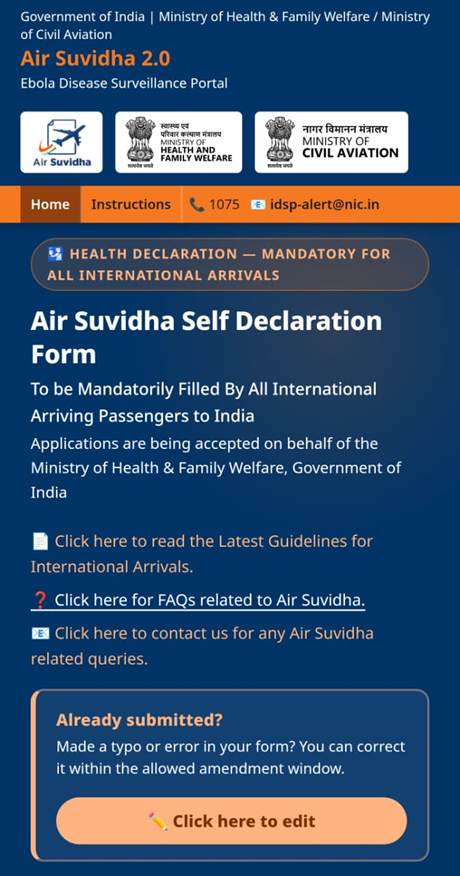
International travellers flying to India have a new health-screening step to plan for after the launch of Air Suvidha 2.0. The Ministry of Civil Aviation and Delhi International Airport Limited launched the upgraded contactless Passenger Health Self-Declaration Portal on 25 June to strengthen public health surveillance at points of entry in response to the ongoing Ebola disease outbreak. The portal lets international arrivals submit a health self-declaration up to 24 hours before arrival through airsuvidha.civilaviation.gov.in.
The form applies to all passengers flying into India from any country, including the large number of travellers from the UAE. The platform requires travellers to disclose recent travel history, possible exposure and symptoms linked to Ebola, and that the information will be shared in real time with airport health officers, immigration officials, the Integrated Disease Surveillance Programme and state surveillance teams.
The timing comes from a public-health alert. The launch followed the World Health Organization's 17 May declaration of the Ebola/Bundibugyo virus disease outbreak in the Democratic Republic of the Congo and Uganda as a Public Health Emergency of International Concern. The current outbreak has been confirmed as Bundibugyo virus disease and neighbouring countries including South Sudan have been assessed as high risk for transmission.
For travellers, the practical instruction is simple: complete the self-declaration before boarding or during web check-in, then keep the downloaded form ready for the International Travel Health Desk or immigration counter on arrival. The form asks for information such as recent travel history, exposure history and symptoms. The goal is to reduce paper handling, speed up screening and help authorities identify at-risk travellers early.
The measure does not mean India is closing its borders or that every arriving passenger is suspected of illness. It is a surveillance tool. Airports are high-risk points for infectious-disease spread because passengers can move from one outbreak zone to another country before symptoms are obvious. A digital declaration gives officials a faster way to triage risk, especially when combined with health desks and immigration data.
The travel impact will depend on execution. If the portal works smoothly, most passengers should treat it like another pre-arrival form. If the portal is unreliable or airlines apply the rule unevenly, it could create confusion at check-in. Airlines, airports and travel agents will need to communicate clearly, especially to older passengers, families, migrant workers and people who do not regularly use digital travel systems.
The return of an Air Suvidha-style form also brings back memories of pandemic-era travel paperwork. The difference is that this version is tied to a specific outbreak and a contactless screening objective. Authorities should keep the requirement proportionate and update it as global risk changes. Travellers should not wait until they reach the airport to check the rule.
For now, anyone flying to India should add Air Suvidha 2.0 to the pre-departure checklist: passport, ticket, visa if required, health declaration and downloaded confirmation. It is a small step, but missing it could mean avoidable delay before boarding or arrival.
Related Stories

EIH And Bhartiya Plan 20 Luxury Resorts Starting With Coorg Kabini And Hampi
EIH Limited and Bhartiya Hospitality have announced a strategic partnership to develop and operate 20 luxury lifestyle resorts across India and selected...

Air India Phuket-Delhi Flight AI2379 Hits Severe Turbulence And Injures Passengers
An Air India flight from Phuket to Delhi has put turbulence safety back in focus after a severe mid-air incident injured passengers and crew before the...

India Identifies 40 Cities For Hub-Airport Travel And Cargo Clearance Model
India has identified 40 cities where passengers could benefit from liberalised airport immigration and cargo-screening rules under a hub-and-spoke aviation model.
